

Page Summary
-
Hotel ad groups can be partitioned into listing groups across multiple dimensions to adjust bids for each group.
-
Each listing group node is either a subdivision, which adds a level to the tree, or a unit, which is a leaf.
-
A valid listing group tree must have at least one unit node and each subdivision must be completely partitioned with a node representing "Other".
-
Bids can only be set on unit nodes using the
percent_cpc_bid_microsfield. -
Temporary negative integer IDs can be used for child nodes in a single mutate request before they are assigned positive global IDs by the server.
Hotel ad groups support partitioning your hotels into many hotel listing groups across multiple dimensions so you can adjust bids for each group accordingly. Consider the following tree, where at the first level, the hotels have been broadly divided as 5-star hotels, 4-star hotels, and other hotel classes. At the second level, the hotels in other hotel classes have been divided as "United States" hotels, "United Kingdom" hotels, and hotels in other regions.
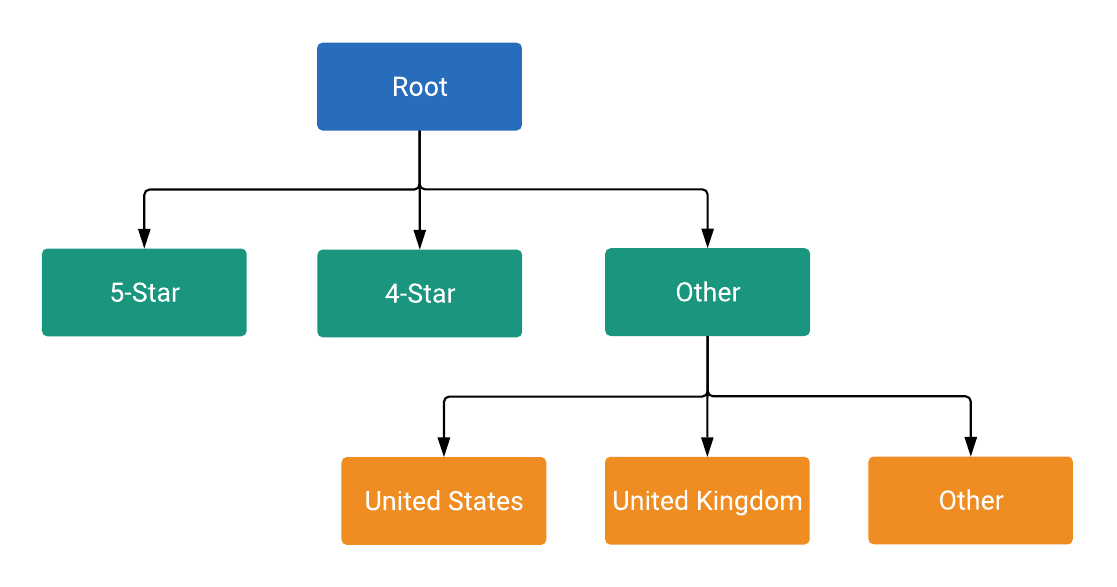
Each node in the tree is either a subdivision or a unit, as defined by
ListingGroupType. A subdivision introduces a new level
in the tree, while units are leaves of the tree. Each subdivision must always
be completely partitioned, so it must contain a node representing Other. In
the example, the root and Hotel Class: (Other) nodes are subdivisions. This
tree structure with subdivisions and units lets you set bids at the unit level
and ensures that every hotel listing falls into one and only one unit node in
the tree.
Nodes are objects of the ListingGroupInfo class, which
contains the ListingGroupType field that indicates
whether the nodes are unit or subdivision. Setting ListingGroupInfo to
listing_group of AdGroupCriterion links it to the
AdGroup.
Set Percent CPC bids
You can set bids (such as percent_cpc_bid_micros or
cpc_bid_micros, depending on your bidding strategy) on
AdGroupCriterion only for unit nodes. Attempting to set
bids on subdivision nodes fails with an error.
Dimensions for hotel listing groups
A ListingGroupInfo also has a
case_value, which is a
ListingDimensionInfo that contains one of several
dimension types. A ListingGroupInfo represents the values associated with
your hotels, such as hotel ID, hotel country, or hotel class. A full
description of the available ListingDimensionInfo types is available in the
ListingDimensionInfo reference documentation.
Each immediate child of a subdivision must have a case_value of the same
ListingDimensionInfo subtype. Only the root node doesn't have a case_value.
Remember that each subdivision must contain an empty case_value of the
correct type, representing all Other values.
For more details, check out the following code snippet, which adds the first level of the listing group tree:
Java
private static String addLevel1Nodes( long customerId, long adGroupId, String rootResourceName, List<AdGroupCriterionOperation> operations, long percentCpcBidMicroAmount) { // Creates hotel class info and dimension info for 5-star hotels. ListingDimensionInfo fiveStarredDimensionInfo = ListingDimensionInfo.newBuilder() .setHotelClass(HotelClassInfo.newBuilder().setValue(5).build()) .build(); // Creates listing group info for 5-star hotels as a UNIT node. ListingGroupInfo fiveStarredUnit = ListingGroupInfo.newBuilder() .setType(ListingGroupType.UNIT) .setParentAdGroupCriterion(rootResourceName) .setCaseValue(fiveStarredDimensionInfo) .build(); // Creates an ad group criterion for 5-star hotels. AdGroupCriterion fiveStarredAdGroupCriterion = createAdGroupCriterion(customerId, adGroupId, fiveStarredUnit, percentCpcBidMicroAmount); // Decrements the temp ID for the next ad group criterion. AdGroupCriterionOperation operation = generateCreateOperation(fiveStarredAdGroupCriterion); operations.add(operation); // You can also create more UNIT nodes for other hotel classes by copying the above code in // this method and modifying the value passed to HotelClassInfo() to the value you want. // For instance, passing 4 instead of 5 in the above code will create a UNIT node of 4-star // hotels instead. // Creates hotel class info and dimension info for other hotel classes by not specifying // any attributes on those object. ListingDimensionInfo otherHotelsDimensionInfo = ListingDimensionInfo.newBuilder() .setHotelClass(HotelClassInfo.newBuilder().build()) .build(); // Creates listing group info for other hotel classes as a SUBDIVISION node, which will be // used as a parent node for children nodes of the next level. ListingGroupInfo otherHotelsSubdivision = createListingGroupInfo( ListingGroupType.SUBDIVISION, rootResourceName, otherHotelsDimensionInfo); // Creates an ad group criterion for other hotel classes. AdGroupCriterion otherHotelsAdGroupCriterion = createAdGroupCriterion( customerId, adGroupId, otherHotelsSubdivision, percentCpcBidMicroAmount); operation = generateCreateOperation(otherHotelsAdGroupCriterion); operations.add(operation); return otherHotelsAdGroupCriterion.getResourceName(); }
C#
private string AddLevel1Nodes(long customerId, long adGroupId, string rootResourceName, List<AdGroupCriterionOperation> operations, long percentCpcBidMicroAmount) { // Create listing dimension info for 5-star class hotels. ListingDimensionInfo fiveStarredListingDimensionInfo = new ListingDimensionInfo { HotelClass = new HotelClassInfo { Value = 5 } }; // Create a listing group info for 5-star hotels as a UNIT node. ListingGroupInfo fiveStarredUnit = CreateListingGroupInfo(ListingGroupType.Unit, rootResourceName, fiveStarredListingDimensionInfo); // Create an ad group criterion for 5-star hotels. AdGroupCriterion fiveStarredAdGroupCriterion = CreateAdGroupCriterion(customerId, adGroupId, fiveStarredUnit, percentCpcBidMicroAmount); // Create an operation and add it to the list of operations. operations.Add(new AdGroupCriterionOperation { Create = fiveStarredAdGroupCriterion }); // Decrement the temp ID for the next ad group criterion. nextTempId--; // You can also create more UNIT nodes for other hotel classes by copying the above code // in this method and modifying the value passed to HotelClassInfo(). // For instance, passing 4 instead of 5 in the above code will instead create a UNIT // node of 4-star hotels. // Create hotel class info and dimension info for other hotel classes by *not* // specifying any attributes on those object. ListingDimensionInfo otherHotelsListingDimensionInfo = new ListingDimensionInfo { HotelClass = new HotelClassInfo() }; // Create listing group info for other hotel classes as a SUBDIVISION node, which will // be used as a parent node for children nodes of the next level. ListingGroupInfo otherHotelsSubdivisionListingGroupInfo = CreateListingGroupInfo (ListingGroupType.Subdivision, rootResourceName, otherHotelsListingDimensionInfo); // Create an ad group criterion for other hotel classes. AdGroupCriterion otherHotelsAdGroupCriterion = CreateAdGroupCriterion(customerId, adGroupId, otherHotelsSubdivisionListingGroupInfo, percentCpcBidMicroAmount); // Create an operation and add it to the list of operations. operations.Add(new AdGroupCriterionOperation { Create = otherHotelsAdGroupCriterion }); // Decrement the temp ID for the next ad group criterion. nextTempId--; return otherHotelsAdGroupCriterion.ResourceName; }
PHP
private static function addLevel1Nodes( int $customerId, int $adGroupId, string $rootResourceName, array &$operations, int $percentCpcBidMicroAmount ) { // Creates hotel class info and dimension info for 5-star hotels. $fiveStarredDimensionInfo = new ListingDimensionInfo( [ 'hotel_class' => new HotelClassInfo(['value' => 5]) ] ); // Creates listing group info for 5-star hotels as a UNIT node. $fiveStarredUnit = self::createListingGroupInfo( ListingGroupType::UNIT, $rootResourceName, $fiveStarredDimensionInfo ); // Creates an ad group criterion for 5-star hotels. $fiveStarredAdGroupCriterion = self::createAdGroupCriterion( $customerId, $adGroupId, $fiveStarredUnit, $percentCpcBidMicroAmount ); // Decrements the temp ID for the next ad group criterion. self::$nextTempId--; $operation = self::generateCreateOperation($fiveStarredAdGroupCriterion); $operations[] = $operation; // You can also create more UNIT nodes for other hotel classes by copying the above code in // this method and modifying the value passed to HotelClassInfo() to the value you want. // For instance, passing 4 instead of 5 in the above code will create a UNIT node of 4-star // hotels instead. // Creates hotel class info and dimension info for other hotel classes by *not* specifying // any attributes on those object. $othersHotelsDimensionInfo = new ListingDimensionInfo( [ 'hotel_class' => new HotelClassInfo() ] ); // Creates listing group info for other hotel classes as a SUBDIVISION node, which will be // used as a parent node for children nodes of the next level. $otherHotelsSubDivision = self::createListingGroupInfo( ListingGroupType::SUBDIVISION, $rootResourceName, $othersHotelsDimensionInfo ); // Creates an ad group criterion for other hotel classes. $otherHotelsAdGroupCriterion = self::createAdGroupCriterion( $customerId, $adGroupId, $otherHotelsSubDivision, $percentCpcBidMicroAmount ); $operation = self::generateCreateOperation($otherHotelsAdGroupCriterion); $operations[] = $operation; self::$nextTempId--; return $otherHotelsAdGroupCriterion->getResourceName(); }
Python
def add_level1_nodes( client: GoogleAdsClient, customer_id: str, ad_group_id: str, root_resource_name: str, operations: List[AdGroupCriterionOperation], percent_cpc_bid_micro_amount: int, ) -> str: """Creates child nodes on level 1, partitioned by the hotel class info. Args: client: The Google Ads API client. customer_id: The Google Ads customer ID. ad_group_id: The ad group ID to which the hotel listing group will be added. root_resource_name: The string resource name of the listing group's root node. operations: A list of AdGroupCriterionOperations. percent_cpc_bid_micro_amount: The CPC bid micro amount to be set on created ad group criteria. Returns: The string resource name of the "other hotel classes" node, which serves as the parent node for the next level of the listing tree. """ global next_temp_id # Create listing dimension info for 5-star class hotels. five_starred_listing_dimension_info: ListingDimensionInfo = client.get_type( "ListingDimensionInfo" ) five_starred_listing_dimension_info.hotel_class.value = 5 # Create a listing group info for 5-star hotels as a UNIT node. five_starred_unit: ListingGroupInfo = create_listing_group_info( client, client.enums.ListingGroupTypeEnum.UNIT, root_resource_name, five_starred_listing_dimension_info, ) # Create an ad group criterion for 5-star hotels. five_starred_ad_group_criterion: AdGroupCriterion = ( create_ad_group_criterion( client, customer_id, ad_group_id, five_starred_unit, percent_cpc_bid_micro_amount, ) ) # Create an operation and add it to the list of operations. five_starred_ad_group_criterion_operation: AdGroupCriterionOperation = ( client.get_type("AdGroupCriterionOperation") ) client.copy_from( five_starred_ad_group_criterion_operation.create, five_starred_ad_group_criterion, ) operations.append(five_starred_ad_group_criterion_operation) # Decrement the temp ID for the next ad group criterion. next_temp_id -= 1 # You can also create more UNIT nodes for other hotel classes by copying the # above code in this method and modifying the hotel class value. # For instance, passing 4 instead of 5 in the above code will instead create # a UNIT node of 4-star hotels. # Create hotel class info and dimension info without any specifying # attributes. This node will then represent hotel classes other than those # already covered by UNIT nodes at this level. other_hotels_listing_dimension_info: ListingDimensionInfo = client.get_type( "ListingDimensionInfo" ) # Set "hotel_class" as the oneof field on the ListingDimensionInfo object # without specifying the optional hotel_class field. client.copy_from( other_hotels_listing_dimension_info.hotel_class, client.get_type("HotelClassInfo"), ) # Create listing group info for other hotel classes as a SUBDIVISION node, # which will be used as a parent node for children nodes of the next level. other_hotels_subdivision_listing_group_info: ListingGroupInfo = ( create_listing_group_info( client, client.enums.ListingGroupTypeEnum.SUBDIVISION, root_resource_name, other_hotels_listing_dimension_info, ) ) # Create an ad group criterion for other hotel classes. other_hotels_ad_group_criterion: AdGroupCriterion = ( create_ad_group_criterion( client, customer_id, ad_group_id, other_hotels_subdivision_listing_group_info, percent_cpc_bid_micro_amount, ) ) # Create an operation and add it to the list of operations. other_hotels_ad_group_criterion_operation: AdGroupCriterionOperation = ( client.get_type("AdGroupCriterionOperation") ) client.copy_from( other_hotels_ad_group_criterion_operation.create, other_hotels_ad_group_criterion, ) operations.append(other_hotels_ad_group_criterion_operation) # Decrement the temp ID for the next ad group criterion. next_temp_id -= 1 return other_hotels_ad_group_criterion.resource_name
Ruby
def add_level1_nodes( client, customer_id, ad_group_id, root_resource_name, operations, percent_cpc_bid_micro_amount) # Creates hotel class info and dimension info for 5-star hotels. five_starred_dimension_info = client.resource.listing_dimension_info do |d| d.hotel_class = client.resource.hotel_class_info do |c| c.value = 5 end end # Creates listing group info for 5-star hotels as a UNIT node. five_starred_unit = create_listing_group_info( client, :UNIT, root_resource_name, five_starred_dimension_info, ) # Creates an ad group criterion for 5-star hotels. five_starred_ad_group_criterion = create_ad_group_criterion( client, customer_id, ad_group_id, five_starred_unit, percent_cpc_bid_micro_amount, ) operations << generate_create_operation( client, five_starred_ad_group_criterion, ) # You can also create more UNIT nodes for other hotel classes by copying the # above code in this method and modifying the value passed to HotelClassInfo() # to the value you want. # For instance, passing 4 instead of 5 in the above code will create a UNIT # node of 4-star hotels instead. # Creates hotel class info and dimension info for other hotel classes # by *not* specifying any attributes on those object. other_hotels_dimention_info = client.resource.listing_dimension_info do |d| d.hotel_class = client.resource.hotel_class_info end # Creates listing group info for other hotel classes as a SUBDIVISION node, # which will be used as a parent node for children nodes of the next level. other_hotels_subdivision = create_listing_group_info( client, :SUBDIVISION, root_resource_name, other_hotels_dimention_info, ) # Creates an ad group criterion for other hotel classes. other_hotels_ad_group_criterion = create_ad_group_criterion( client, customer_id, ad_group_id, other_hotels_subdivision, percent_cpc_bid_micro_amount, ) operations << generate_create_operation( client, other_hotels_ad_group_criterion, ) other_hotels_ad_group_criterion.resource_name end
Perl
sub add_level_1_nodes { my ($customer_id, $ad_group_id, $root_resource_name, $operations, $percent_cpc_bid_micro_amount) = @_; # Create hotel class info and dimension info for 5-star hotels. my $five_starred_dimension_info = Google::Ads::GoogleAds::V25::Common::ListingDimensionInfo->new({ hotelClass => Google::Ads::GoogleAds::V25::Common::HotelClassInfo->new({ value => 5 })}); # Create listing group info for 5-star hotels as a UNIT node. my $five_starred_unit = create_listing_group_info(UNIT, $root_resource_name, $five_starred_dimension_info); # Create an ad group criterion for 5-star hotels. my $five_starred_ad_group_criterion = create_ad_group_criterion($customer_id, $ad_group_id, $five_starred_unit, $percent_cpc_bid_micro_amount); my $operation = generate_create_operation($five_starred_ad_group_criterion); push @$operations, $operation; # You can also create more UNIT nodes for other hotel classes by copying the # above code in this method and modifying the value passed to HotelClassInfo # to the value you want. For instance, passing 4 instead of 5 in the above code # will create a UNIT node of 4-star hotels instead. # Create hotel class info and dimension info for other hotel classes by *not* # specifying any attributes on those object. my $others_hotels_dimension_info = Google::Ads::GoogleAds::V25::Common::ListingDimensionInfo->new({ hotelClass => Google::Ads::GoogleAds::V25::Common::HotelClassInfo->new()} ); # Create listing group info for other hotel classes as a SUBDIVISION node, which # will be used as a parent node for children nodes of the next level. my $other_hotels_subdivision = create_listing_group_info(SUBDIVISION, $root_resource_name, $others_hotels_dimension_info); # Create an ad group criterion for other hotel classes. my $other_hotels_ad_group_criterion = create_ad_group_criterion($customer_id, $ad_group_id, $other_hotels_subdivision, $percent_cpc_bid_micro_amount); $operation = generate_create_operation($other_hotels_ad_group_criterion); push @$operations, $operation; return $other_hotels_ad_group_criterion->{resourceName}; }
curl
Available dimensions for ListingDimensionInfo
The following ListingDimensionInfo types are available for Hotel Ads:
Temporary IDs
Ad group criteria aren't assigned IDs until the mutate request that creates
them is processed by the server. However, a ListingGroupInfo is invalid until
it is complete, so whenever you create a subdivision you must also create at
least one of its children in the same operation.
To set the parent_ad_group_criterion of
ListingGroupInfo for the child nodes, you can use
temporary criterion IDs. These are locally unique (rather than globally unique)
identifiers that apply only within the context of a single mutate request. Any
unique negative integer (for example, -1, -2, -3) can be used as a
temporary ID within a single request.
When the request is processed, each AdGroupCriterion is
assigned a positive global ID as usual.