

Page Summary
-
Responsive search ads use multiple headlines and descriptions that rotate to find the best performing combinations.
-
You can pin specific headlines and descriptions to always appear in certain positions in the ad.
-
Performance statistics are collected on different combinations to optimize ad effectiveness.
-
The displayed URL can be customized using
path1andpath2fields.
Use responsive search ads to promote products on the Google Network. The main features of responsive search ads are that they let you:
- Set three to 15 headlines and two to four descriptions that automatically rotate into the ad to determine which combinations perform best.
- Pin any headlines and descriptions you want so that they always appear in a designated position in the ad.
- Collect performance statistics on different combinations of headlines and descriptions so you can evaluate their effectiveness. The system automatically favors headline and description combinations that work well together.
- Display customized URLs by specifying
path1andpath2, which are appended to the end of your landing page domain to form the displayed URL.
Format
Responsive search ads can display up to three headlines and up to two
descriptions at serve time, plus a customizable URL based on the landing page
domain and how you configure the path1 and path2 fields on your
ResponsiveSearchAdInfo object.
Here's an example of what a responsive search ad looks like:
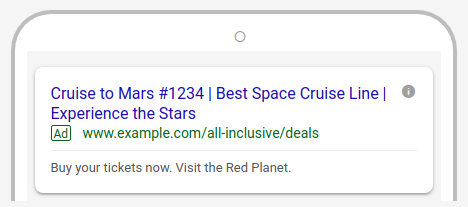
Headlines and descriptions are configured as arrays of
AdTextAsset message objects inside
ResponsiveSearchAdInfo.
Pin assets to specific positions
Responsive search ads also support asset pinning. If you want finer control
than allowing the system to mix and match all headlines and descriptions, you
can pin headlines and descriptions to specific positions using the
pinned_field property on AdTextAsset (or
pinnedField in JSON requests). Valid
ServedAssetFieldType values for
pinned_field are:
- Headlines:
HEADLINE_1,HEADLINE_2, orHEADLINE_3 - Descriptions:
DESCRIPTION_1orDESCRIPTION_2
For example, if you want a specific headline to always appear first, set its
pinned_field to
ServedAssetFieldType.HEADLINE_1. Whenever that ad is served,
that specific text appears in the first headline position and the remaining
positions are drawn from the pool of unpinned assets. If more than one asset is
pinned to the same position, that position rotates text among the assets pinned
to it.
When pinning assets in headlines or descriptions, every position
(HEADLINE_1–HEADLINE_3 for headlines; DESCRIPTION_1–DESCRIPTION_2 for
descriptions) must be fillable either by an asset pinned to that position or by
a distinct unpinned asset. For example, pinning all three headlines in a
3-headline ad to HEADLINE_1 leaves HEADLINE_2 and HEADLINE_3 without
eligible assets and fails with an AssetLinkError of
NOT_ENOUGH_AVAILABLE_ASSET_LINKS_FOR_VALID_COMBINATION (or
NOT_ENOUGH_AVAILABLE_ASSET_LINKS_WITH_FALLBACK_FOR_VALID_COMBINATION
when using ad customizers without default fallback values).
See Create responsive search ads for complete code examples.
Text customization and automatically created assets
When you enable campaign-level text customization (called automatically created assets in the API) on a Search campaign, Google Ads can automatically generate additional headlines and descriptions from your landing page, domain, and ads and keywords to serve alongside your advertiser-provided assets:
- To enable text customization on a Search campaign, set
Campaign.ai_max_setting.enable_ai_maxtotrueto enable AI Max for Search campaigns, and setTEXT_ASSET_AUTOMATIONtoOPTED_INinCampaign.asset_automation_settings. Settingenable_ai_maxtotruealone only enables search term matching by default (TEXT_ASSET_AUTOMATIONandFINAL_URL_EXPANSION_TEXT_ASSET_AUTOMATIONboth default toOPTED_OUTfor Search campaigns). Conversely, setting either automation type toOPTED_INwithoutenable_ai_maxset totruefails withCampaignError.AI_MAX_MUST_BE_ENABLED. - You can enable
TEXT_ASSET_AUTOMATIONwhile leavingFINAL_URL_EXPANSION_TEXT_ASSET_AUTOMATIONset toOPTED_OUT. However, settingFINAL_URL_EXPANSION_TEXT_ASSET_AUTOMATIONtoOPTED_INrequiresTEXT_ASSET_AUTOMATIONto also be set toOPTED_IN; opting in toFINAL_URL_EXPANSION_TEXT_ASSET_AUTOMATIONwhileTEXT_ASSET_AUTOMATIONisOPTED_OUTfails withContextError.OPERATION_NOT_PERMITTED_FOR_CONTEXT. - You can configure campaign-level
Campaign.text_guidelines(TextGuidelines) to specify exact term exclusions (term_exclusions) and freeform messaging restrictions (messaging_restrictions) for automatically generated text assets in Search campaigns with AI Max for Search campaigns enabled. - Because automatically created assets aren't returned in
ad_group_ad.ad.responsive_search_adand can't be removed usingAdService.MutateAds, you can remove unwanted ad-level automatically created headlines and descriptions usingAdGroupAdService.RemoveAutomaticallyCreatedAssets(or remove campaign-level Final URL expansion text assets usingRemoveCampaignAutomaticallyCreatedAssetonAutomaticallyCreatedAssetRemovalService). - You can query the read-only
Campaign.aca_migration_date_timefield to check when a Search campaign using automatically created assets was migrated to AI Max for Search campaigns.
For configuration details, see Asset automation settings and Get started with AI Max for Search campaigns. To distinguish between advertiser-provided and automatically created assets in reports, see Retrieve responsive search ads.
Additional resources
To learn more about working with responsive search ads in the Google Ads API and Google Ads, see the following guides and Help Center articles:
- Create responsive search ads
- Mutate ads
- Customize responsive search ads
- Retrieve responsive search ads
- About responsive search ads
- Create effective Search ads