

يمكنك تصنيف العملاء الذي يمكن الوصول إليهم باستخدام إجراء ListAccessibleCustomers في CustomerService. ومع ذلك، عليك فهم أي نوع من العملاء يتم عرضهم في هذا النوع من الطلبات.
تصنيف العملاء الذين يمكن الوصول إليهم هو أحد الطلبات القليلة في Google Ads API الذي لا يتطلّب منك تحديد الرقم التعريفي للعميل في الطلب، وسيتجاهل الطلب أي معرّف login-customer-id.
تستند قائمة العملاء الناتجة إلى بيانات اعتماد OAuth الخاصة بك. ويعرض الطلب قائمة بجميع الحسابات التي يمكنك اتخاذ إجراء بشأنها مباشرةً وفقًا لبيانات الاعتماد الحالية. لا يتضمن ذلك بالضرورة جميع الحسابات داخل التسلسل الهرمي للحساب، بل سيتضمن فقط تلك التي تمت فيها إضافة المستخدم المصادق عليه مع منحه حقوق مشرف أو حقوق أخرى في الحساب.
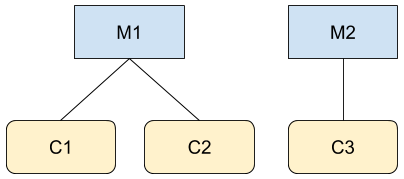
لنفترض أنّك مستخدم في A ومشرف على M1 و C3 في التسلسلين الهرميين الواردين في الشكل. إذا أردت إجراء مكالمة مع Google Ads API، على سبيل المثال، GoogleAdsService، يمكنك الوصول إلى معلومات حسابات M1 وC1 وC2 وC3. ومع ذلك، فإنّ المكالمة الواردة إلى CustomerService.ListAccessibleCustomers ستعرض فقط M1 و C3 لأنّهما الحسابَين الوحيدَين اللّذين يمكن للمستخدم A أن يصل إليهما مباشرةً.
في ما يلي مثال رمز برمجي يوضّح استخدام إجراء CustomerService.ListAccessibleCustomers التالي:
جافا
private void runExample(GoogleAdsClient client) { // Optional: Change credentials to use a different refresh token, to retrieve customers // available for a specific user. // // UserCredentials credentials = // UserCredentials.newBuilder() // .setClientId("INSERT_OAUTH_CLIENT_ID") // .setClientSecret("INSERT_OAUTH_CLIENT_SECRET") // .setRefreshToken("INSERT_REFRESH_TOKEN") // .build(); // // client = client.toBuilder().setCredentials(credentials).build(); try (CustomerServiceClient customerService = client.getLatestVersion().createCustomerServiceClient()) { ListAccessibleCustomersResponse response = customerService.listAccessibleCustomers( ListAccessibleCustomersRequest.newBuilder().build()); System.out.printf("Total results: %d%n", response.getResourceNamesCount()); for (String customerResourceName : response.getResourceNamesList()) { System.out.printf("Customer resource name: %s%n", customerResourceName); } } }
#C
public void Run(GoogleAdsClient client) { // Get the CustomerService. CustomerServiceClient customerService = client.GetService(Services.V25.CustomerService); try { // Retrieve the list of customer resources. string[] customerResourceNames = customerService.ListAccessibleCustomers(); // Display the result. foreach (string customerResourceName in customerResourceNames) { Console.WriteLine( $"Found customer with resource name = '{customerResourceName}'."); } } catch (GoogleAdsException e) { Console.WriteLine("Failure:"); Console.WriteLine($"Message: {e.Message}"); Console.WriteLine($"Failure: {e.Failure}"); Console.WriteLine($"Request ID: {e.RequestId}"); throw; } }
PHP
public static function runExample(GoogleAdsClient $googleAdsClient) { $customerServiceClient = $googleAdsClient->getCustomerServiceClient(); // Issues a request for listing all accessible customers. $accessibleCustomers = $customerServiceClient->listAccessibleCustomers(new ListAccessibleCustomersRequest()); print 'Total results: ' . count($accessibleCustomers->getResourceNames()) . PHP_EOL; // Iterates over all accessible customers' resource names and prints them. foreach ($accessibleCustomers->getResourceNames() as $resourceName) { /** @var string $resourceName */ printf("Customer resource name: '%s'%s", $resourceName, PHP_EOL); } }
Python
def main(client: GoogleAdsClient) -> None: customer_service: CustomerServiceClient = client.get_service( "CustomerService" ) accessible_customers: ListAccessibleCustomersResponse = ( customer_service.list_accessible_customers() ) result_total: int = len(accessible_customers.resource_names) print(f"Total results: {result_total}") resource_names: List[str] = accessible_customers.resource_names for resource_name in resource_names: # resource_name is implicitly str print(f'Customer resource name: "{resource_name}"')
Ruby
def list_accessible_customers() # GoogleAdsClient will read a config file from # ENV['HOME']/google_ads_config.rb when called without parameters client = Google::Ads::GoogleAds::GoogleAdsClient.new accessible_customers = client.service.customer.list_accessible_customers().resource_names accessible_customers.each do |resource_name| puts "Customer resource name: #{resource_name}" end end
Perl
sub list_accessible_customers { my ($api_client) = @_; my $list_accessible_customers_response = $api_client->CustomerService()->list_accessible_customers(); printf "Total results: %d.\n", scalar @{$list_accessible_customers_response->{resourceNames}}; foreach my $resource_name (@{$list_accessible_customers_response->{resourceNames}}) { printf "Customer resource name: '%s'.\n", $resource_name; } return 1; }
curl
# Returns the resource names of customers directly accessible by the user # authenticating the call. # # Variables: # API_VERSION, # OAUTH2_ACCESS_TOKEN: # See https://developers.google.com/google-ads/api/rest/auth#request_headers # for details. # curl -f --request GET \ "https://googleads.googleapis.com/v${API_VERSION}/customers:listAccessibleCustomers" \ --header "Content-Type: application/json" \ --header "Authorization: Bearer ${OAUTH2_ACCESS_TOKEN}" \
عرض قائمة بالحسابات الملغاة
لاسترداد الحسابات التي تم إلغاؤها ضمن حساب إداري، أرسِل طلب بحث إلى مصدر customer_client مباشرةً وفلتر حسب status:
SELECT
  customer_client.id,
  customer_client.descriptive_name,
  customer_client.status
FROM customer_client
WHERE customer_client.status = 'CANCELED'