
In marketing, upper-funnel brand advertising (like TV or video) builds brand awareness and demand over time. Meanwhile, lower-funnel direct-response advertising (like paid search) captures that demand to drive immediate sales or conversions.
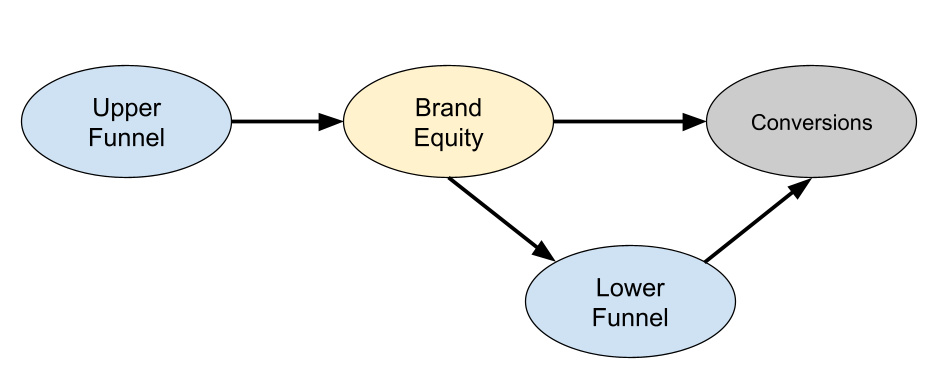
To measure these full-funnel marketing investments, a standard single-stage Marketing Mix Model (MMM) can be reliable, parsimonious, and relatively straightforward to execute. However, because a single-stage MMM analyzes all marketing channels in a single step, it creates a dilemma.
- If you exclude intermediate brand equity variables (like organic search volume), you over-credit lower-funnel channels. They get rewarded for capturing some demand that they didn't actually create.
- If you include intermediate brand equity variables (as standard controls), you under-credit upper-funnel channels. They get stripped of the credit for generating that demand in the first place.
Consider Branded Google Query Volume (bGQV) as an example of a brand equity variable. Single-stage models have a forced trade-off: if you include bGQV as a control variable in the model, you starve brand channels of the credit they deserve for driving that search interest. If you exclude bGQV, you over-credit direct-response ads that harvest existing demand instead of creating it. See Including query volume to learn more about this example.
To measure these full-funnel marketing investments, Meridian now offers full-funnel MMM using a two-stage modeling approach. The stage 1 model measures how brand marketing builds brand equity. The stage 2 model measures how that equity, alongside all marketing, drives the final KPI.
The core problem: a control variable can be a mediator and a confounder
The core causal inference problem of Marketing Mix Modeling (MMM) is the estimation of the joint treatment effect of several different marketing variables. In causal inference, we know that one must include confounding variables in the model, while excluding mediator variables (see Selecting control variables). MMM practitioners often encounter variables that act as mediators for some treatment variables, but confounders for others.
In single-stage MMM, practitioners face a dilemma for such variables that are confounders for some treatment variables, but mediators for others:
- Exclude the variable in the model: fails to account for its confounding effect when estimating the impact of lower-funnel channels, resulting in biased overestimates of lower-funnel channel ROIs.
- Include the variable in the model: blocks the causal path brand advertising has through the variable, resulting in underestimates of brand channel ROIs.
Brand equity variables, such as brand consideration or Branded Google Query Volume (bGQV), are classic examples of such variables. Brand marketing (aka "Upper-funnel marketing") drives brand equity, which in turn drives the KPI, making it a mediator for brand marketing. At the same time, brand equity drives organic demand and activity on lower-funnel channels (like paid search ads). This makes brand equity a confounder for those channels.
How full-funnel MMM works
Meridian solves this core problem by fitting two separate MMM models. In the first model, a brand equity variable is the response variable. In the second model, the brand equity variable is an explanatory variable.
| Funnel Stage | Objective | Treatment variable | Response variable | Required control variables |
|---|---|---|---|---|
| Stage 1 Model: Brand marketing \(\rightarrow\) Brand equity | Captures how brand marketing builds brand equity | Brand marketing (for example, Video, TV, PR) | Brand equity variable (for example, Branded GQV). | Confounders with brand marketing and brand equity |
| Stage 2 Model: Brand equity and Marketing \(\rightarrow\) KPI | Captures how marketing affects KPI, including the demand built by Stage 1 | All marketing and Stage 1's brand equity variable | KPI | Confounders with marketing and KPI and confounders with brand equity and KPI |
To summarize, we are estimating three kinds of causal effects:
- Stage 1: the effect of brand marketing on brand equity.
- Stage 2: the effect of brand equity on KPI.
- Stage 2: the effect of all marketing on KPI.
To estimate these three kinds of effects, we must account for confounders for each causal relationship within the model estimating the causal effect. For more on the causal graph assumed for full-funnel MMM, see the full-funnel causal graph.
Once both models are fit, you must connect their findings. Specifically, you propagate the effect brand marketing has on brand equity (from the first model) to the effect brand equity has on your final KPI (in the second model). The so-called "indirect effect" from the first model is included in estimates of key causal estimates like ROI, marginal ROI, response curves, and budget optimization.
For more details on how to execute full-funnel MMM in Meridian see the
Meridian Full-Funnel
walkthrough. The walkthrough includes all the detailed modeling considerations
and how to propagate the indirect effect with a AnalyzerFullFunnel class.
Choosing between full-funnel MMM and single-stage MMM
Choosing between single-stage MMM and full-funnel MMM comes down to a fundamental trade-off: full-funnel MMM solves the mediator-confounder problem, but requires estimating more causal effects and identifying more confounder variables.
- Single-stage MMM is simpler and only requires identifying confounders between marketing and the final KPI. However, if brand equity is a mediator for brand marketing and a confounder for lower-funnel marketing, you face an unavoidable dilemma: including brand equity under-credits brand channels, while excluding it over-credits lower-funnel channels.
- Full-funnel MMM resolves this dilemma by explicitly modeling the indirect effect through the mediator. However, it requires estimating three kinds of causal effects (brand marketing \(\rightarrow\) brand equity, brand equity \(\rightarrow\) KPI, and all marketing \(\rightarrow\) KPI). You must identify and control for confounders across both stages, which increases data requirements and sensitivity to unobserved confounding.
Full-funnel MMM is worth the added complexity when:
- The indirect path is substantial: Brand marketing has a meaningful effect on brand equity, and brand equity strongly drives sales. If this pathway is weak, single-stage bias is minimal.
- Confounders are measurable for both stages: You have reliable data to control for the three different kinds of necessary confounders.
Otherwise, a single-stage MMM may be the more reliable choice.
A generic framework for brand equity
Branded Google Query Volume (bGQV) is a common brand equity variable for Meridian's full-funnel MMM as it is a mediator for brand marketing and a confounder for lower-funnel marketing (especially search ads). bGQV is available at weekly and geo granularity on the MMM Data Platform.
However, the full-funnel framework is fully generic. It can be applied to any intermediate brand health metric that fits the assumed full-funnel causal graph.