This guide details how to implement DPoP (Demonstrating Proof-of-Possession) in your OAuth 2.0 integrations with Google's OAuth Platform. DPoP (defined in RFC 9449) secures your applications against token theft and replay attacks by cryptographically binding tokens to a client-generated asymmetric key pair.
Authorization Code flow changes
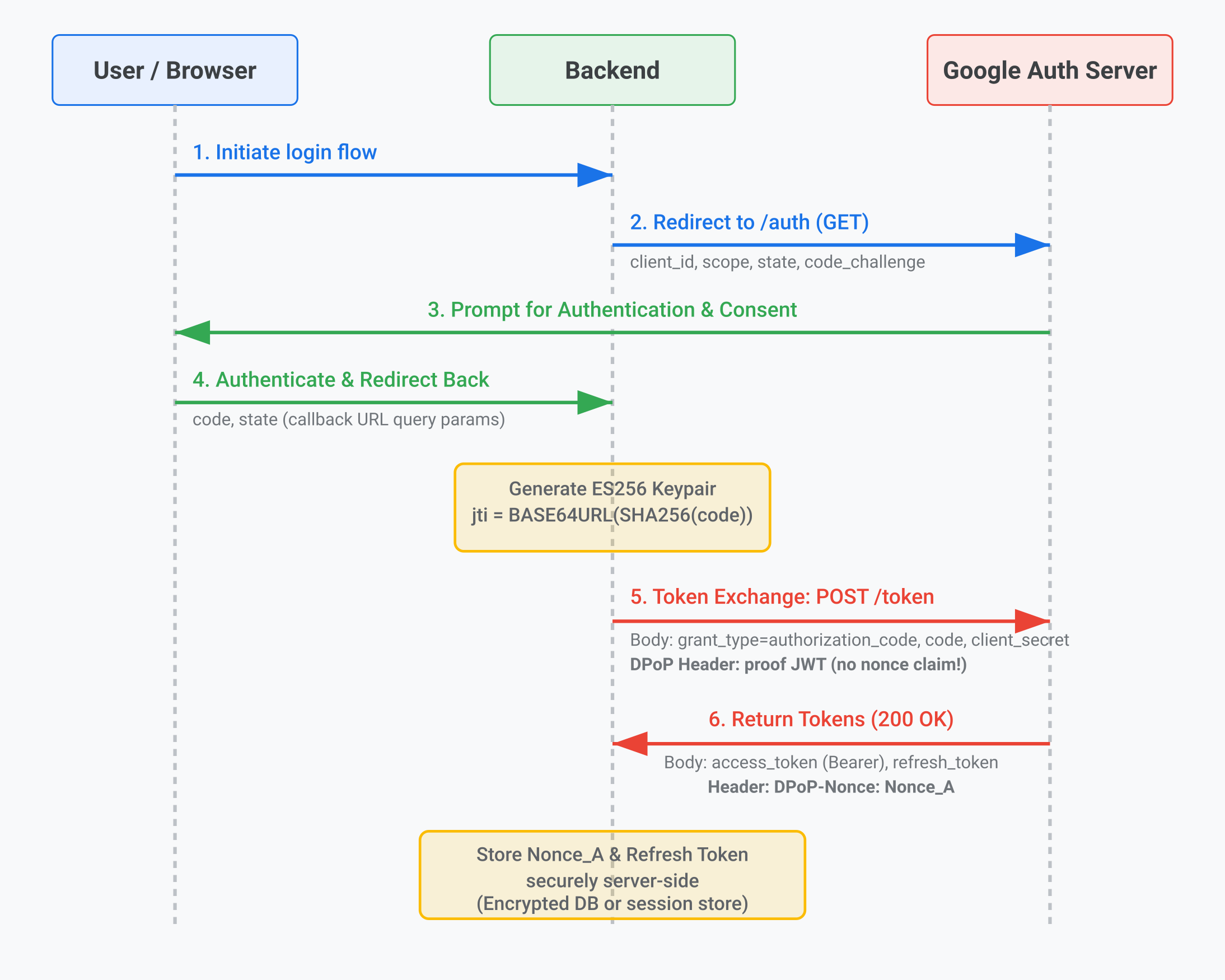
Adding DPoP to an existing OAuth 2.0 Authorization Code flow requires generation and storage of a keypair, construction of a DPoP proof JWT, and including the proof as an HTTP header when the authorization code is exchanged for a refresh token as shown in steps 5 and 6 of Figure 1.
Authorization code request
The authorization request is created normally. For example:
$ curl -G "https://accounts.google.com/o/oauth2/v2/auth" \
  --data-urlencode "client_id=YOUR_CLIENT_ID.apps.googleusercontent.com" \
  --data-urlencode "redirect_uri=http://127.0.0.1:8080" \
  --data-urlencode "response_type=code" \
  --data-urlencode "scope=calendar.readonly" \
  --data-urlencode "state=AI1Bvapj7E5SDmtW4gohcA" \
  --data-urlencode "code_challenge=PO4pPROl-31Wy9fVZ7uTW9Ga6CrjrSKsf4AAtx_JNM8" \
  --data-urlencode "code_challenge_method=S256" \
  --data-urlencode "nonce=PrMfmSNAvJFPQ7GnlEKUaw" \
  --data-urlencode "access_type=offline" \
  --data-urlencode "prompt=consent"
The authorization code returned as a redirect URI parameter is used in the construction of a DPoP proof. The refresh token is bound to the proof included as an HTTP header in all further requests to the token endpoint.
Pure, secretless client-side SPAs cannot use DPoP directly due to the
client_secret requirement and CORS limitations on the DPoP-Nonce header. To
secure SPAs, route traffic through a Backend-for-Frontend (BFF) that acts as a
Confidential Client, enables access_type=offline, and utilizes DPoP to bind
the refresh token server-side.
Construct the DPoP proof
A proof contains a JOSE header and a payload.
To construct the header, generate an EC P-256 (ES256) keypair and include the
public key coordinates (x and y) in the jwk parameter. A RSA keypair is
also possible but not recommended due to higher computational costs.
This is an example JOSE header:
{
  "typ": "dpop+jwt",
  "alg": "ES256",
  "jwk": {
    "kty": "EC",
    "crv": "P-256",
    "x": "VC91y9ZYdfSWaDv8JaI6gx5ifOw2rn3YdqkAB51Uu6E",
    "y": "ikPjOtea4k7fWPVrRYwaA4Ww6iVY3pOOICotHwwGV3o"
  }
}
To construct the proof payload four values are required.
Two claims: htm: POST and htu: https://oauth2.googleapis.com/token are fixed
values and don't change when making a request to Google's token endpoint.
The other two claims: iat and jti must be generated for every request. The
value of iat is the issued-at timestamp and changes per request. The value of
the JWT ID (jti) claim depends on the type of exchange. When an authorization
code is exchanged for access and refresh tokens the value of jti is the
Base-64 and Url-encoded SHA256 hash of the authorization code, such as jti =
BASE64URL(SHA-256(authorization_code)).
This is an example payload body:
{
  "jti": "o29CN8LIY0l_N8iy5-ilon1guad9NFQHFOdXTzrBNck",
  "htm": "POST",
  "htu": "https://oauth2.googleapis.com/token",
  "iat": 1784822025
}
The JOSE header and payload body are encoded as a JWT (RFC7519) for direct use
in the DPoP HTTP header in the token request:
$ curl -X POST https://oauth2.googleapis.com/token \
  -H "Content-Type: application/x-www-form-urlencoded" \
  -H "DPoP: eyJ0eXAiOiJkcG9wK2p3dCIsImFsZyI6IkVTMjU2IiwiandrIjp7Imt0eSI6\
       IkVDIiwiY3J2IjoiUC0yNTYiLCJ4IjoiVkM5MXk5WllkZlNXYUR2OEphSTZneDVpZ\
       k93MnJuM1lkcWtBQjUxVXU2RSIsInkiOiJpa1BqT3RlYTRrN2ZXUFZyUll3YUE0V3\
       c2aVZZM3BPT0lDb3RId3dHVjNvIn19.eyJqdGkiOiJvMjlDTjhMSVkwbF9OOGl5NS\
       1pbG9uMWd1YWQ5TkZRSEZPZFhUenJCTmNrIiwiaHRtIjoiUE9TVCIsImh0dSI6Imh\
       0dHBzOi8vb2F1dGgyLmdvb2dsZWFwaXMuY29tL3Rva2VuIiwiaWF0IjoxNzg0ODIy\
       MDI1fQ.OSdQCmqTng_uZmGK5UXf8hcEMtoOu7ucmYtl5mx4901RXnj6fJRJQmIeTq\
       fhprRBTG_RSJv2fPcWDqvQbDW7YA" \
  --data-urlencode "grant_type=authorization_code" \
  --data-urlencode "code=4/0AXEQxIDNpLD-qpSIvjHb2Hl10uS_2sk2GBRpO8UJQ78YZF3hZ9LB9kTA1xYLD4xisi4C5w" \
  --data-urlencode "redirect_uri=http://127.0.0.1:8080" \
  --data-urlencode "client_id=YOUR_CLIENT_ID.apps.googleusercontent.com" \
  --data-urlencode "client_secret=YOUR_CLIENT_SECRET" \
  --data-urlencode "code_verifier=q8ZztyVv7HH8E2M-SEL8WaB-7CPs68rejN5UZ9OdYgo"
A DPoP bound refresh token is returned along with a DPoP-Nonce HTTP header,
for example:
HTTP/1.1 200 OK
Content-Type: application/json; charset=utf-8
DPoP-Nonce: AN3XwJjZsjnb0ZuWkRlek8QU7wY-Zhf-5IP6tO0tORz0KgtDT1Bo8FX-w4nz3r5lnepI

{
  "access_token": "ya29.a0ARGnu0aebRL97B91dmvm14gTug5wpItFf9MVWq12Hja6yv09A_qxa4T73_z2gFbf32qR4RXispQ7vnOzv6gn0APLQrF51LVa6AOqCVPH2Tupocv8y0JHu4ByEbvgXEEhiHEU8Xa9_w3i-PKBPsKWiLi210RCZdqJjLXkcRrGnoPPjbGPzOPtm6KCJjPrNHG16caOWecaCgYKASESARASFQHGX2MiBn7ihbbk_n-buCbOfl2TDA0206",
  "expires_in": 3599,
  "refresh_token": "1//06dUPZ9FIBQm3CgYIARAAGAYSNwF-L9IrJwuIEKUA_zbBPU-xoCDGM0QrDu7-jv7cMQZ0kARPUK9WhwfFFfbOVEgXDQKmFh4w9GM",
  "scope": "https://www.googleapis.com/auth/calendar.readonly",
  "token_type": "Bearer"
}
The nonce generated by Google's authorization server must be included in every
subsequent token request. Note that a nonce value is used only once and a
missing, invalid, expired, or reused nonce value is rejected with an HTTP 400
response. In this case a new nonce is returned for use in retries.
Token refresh flow changes
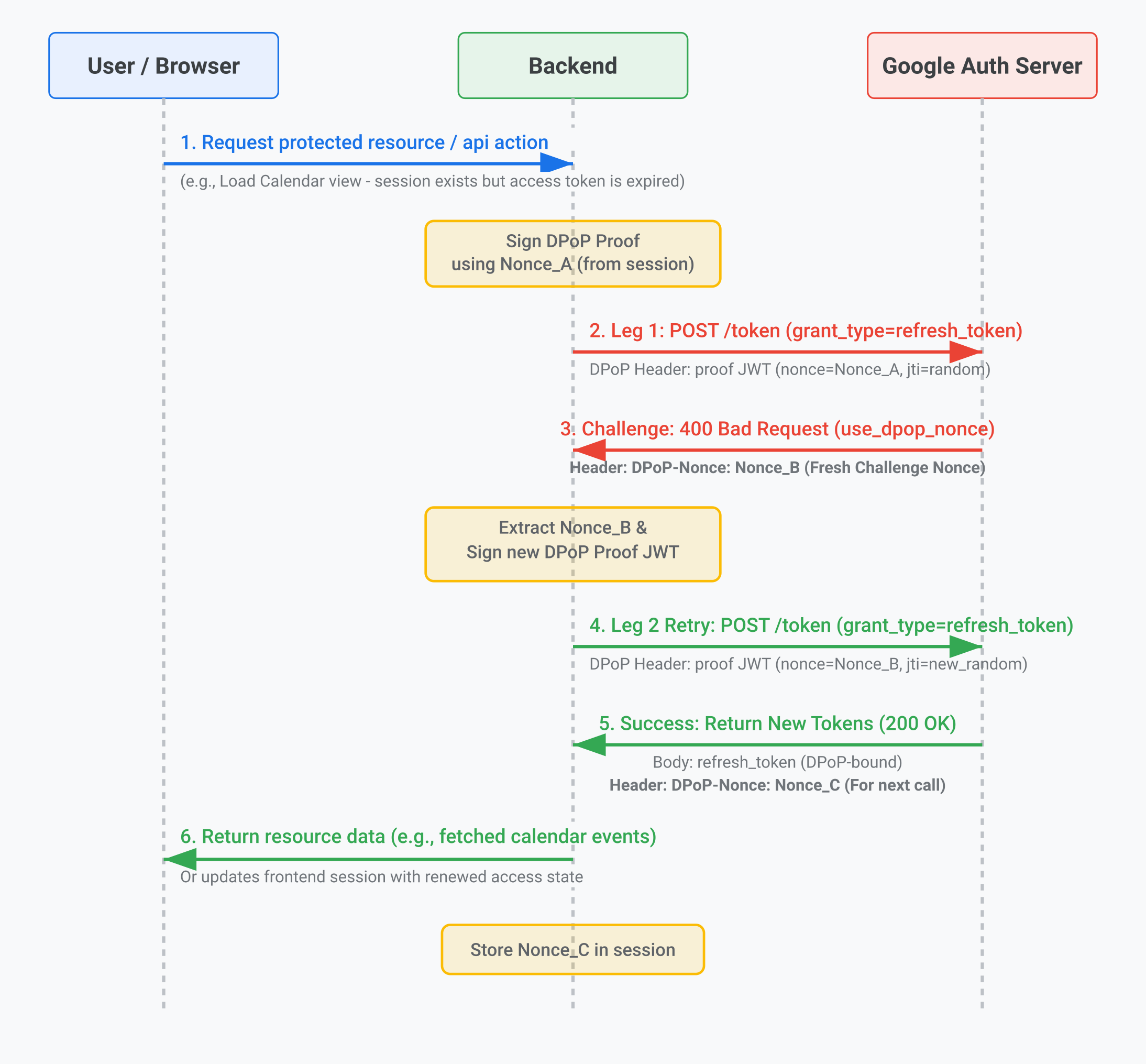
Updating an existing OAuth 2.0 Token Refresh flow requires the generation and sending of a DPoP proof as an HTTP header when a refresh token is exchanged for new tokens as shown in steps 2-5 of Figure 2.
Building the DPoP proof
The method to construct a proof for token refresh differs from the authorization
code scenario. The JOSE header is constructed in the same manner as described
previously when building an authorization code request. The proof body is
constructed similarly but includes a nonce claim and jti contains a unique
random string.
To construct the payload body the previously returned DPoP-Nonce HTTP header
value must be included in the nonce claim and the issued-at timestamp (iat)
updated for every request. The JWT ID (jti) is a unique random string
generated per request, using the built-in WebCrypto API
crypto.getRandomValues(new Uint8Array(24)) and Base64URL-encoding the string.
This is an example payload body containing jti, nonce, and iat:
{
  "jti": "o29CN8ZIY0l_K8iy5-ilon1gwad9NF6HFOdXTzrBNck",
  "htm": "POST",
  "htu": "https://oauth2.googleapis.com/token",
  "nonce": "AN3XwJjZsjnb0ZuWkRlek8QU7wY-Zhf-5IP6tO0tORz0KgtDT1Bo8FX-w4nz3r5lnepI",
  "iat": 1784822025
}
The JOSE header and payload body are encoded as a JWT (RFC7519) for direct use in the DPoP HTTP header in the token request.
The proof is added as a DPoP header to the token refresh request:
$ curl -X POST https://oauth2.googleapis.com/token \
  -H "Content-Type: application/x-www-form-urlencoded" \
  -H "DPoP: eyJ0eXAiOiJkcG9wK2p3dCIsImFsZyI6IkVTMjU2IiwiandrIjp7Imt0eSI6\
       IkVDIiwiY3J2IjoiUC0yNTYiLCJ4IjoiVkM5MXk5WllkZlNXYUR2OEphSTZneDVpZ\
       k93MnJuM1lkcWtBQjUxVXU2RSIsInkiOiJpa1BqT3RlYTRrN2ZXUFZyUll3YUE0V3\
       c2aVZZM3BPT0lDb3RId3dHVjNvIn19.eyJqdGkiOiJvMjlDTjhaSVkwbF9LOGl5NS\
       1pbG9uMWd1YWQ5TkY2SEZPZFhUenJCTmNrIiwiaHRtIjoiUE9TVCIsImh0dSI6Imh\
       0dHBzOi8vb2F1dGgyLmdvb2dsZWFwaXMuY29tL3Rva2VuIiwibm9uY2UiOiJBTjNY\
       d0pqWnNqbmIwWnVXa1JsZWs4UVU3d1ktWmhmLTVJUDZ0TzB0T1J6MEtndERUMUJvO\
       EZYLXc0bnozcjVsbmVwSSIsImlhdCI6MTc4NDgyMjAyNX0.MEQCIDm09AXo2c9sov\
       GrTUkrbEB_k9mra_Dkji-CQ9mSZVP1AiBxbiqkCE7Dt9RKyUT_3kj7q1vCvVggwnW\
       JNX3P3vO1mw" \
  --data-urlencode "grant_type=refresh_token" \
  --data-urlencode "refresh_token=1//06dUPZ9FIBQm3CgYIARAAGAYSNwF-L9IrJwuIEKUA_zbBPU-xoCDGM0QrDu7-jv7cMQZ0kARPUK9WhwfFFfbOVEgXDQKmFh4w9GM" \
  --data-urlencode "client_id=YOUR_CLIENT_ID.apps.googleusercontent.com" \
  --data-urlencode "client_secret=YOUR_CLIENT_SECRET"
When an expired, incorrect, or reused nonce is used or when transitioning
between different OAuth workflows (such as moving from the initial Authorization
Code Exchange to a Token Refresh request) Google's server enforces workflow
isolation. This means the server unconditionally rejects the nonce with an HTTP
400 use_dpop_nonce challenge to establish a fresh nonce namespace for the
new workflow.
This is an example 400 response that requires a retry and a new proof to be
constructed using the DPoP-Nonce value:
HTTP/1.1 400 Bad Request
Content-Type: application/json; charset=utf-8
DPoP-Nonce: AO4t07Kf85RJXmltUhiAiELLPPrJ4zOi66zWxU1uDZbhRcahFBYvT0WlcjSSXULXknSA

{
  "error": "use_dpop_nonce",
  "error_description": "New DPoP nonce issued due to invalid or expired challenge."
}
On success, a new nonce and short-lived access token are returned:
HTTP/1.1 200 OK
Content-Type: application/json; charset=utf-8
DPoP-Nonce: AO4t07IXuovyCbtLEr6VVFZQ_Kb78MMOXTt6-CyZpsJeF62HZ3P_EW55XbWqYcU76Jg=

{
  "access_token": "ya29.a0ARGnu0bDj9BAQYVbF5hi3vw-brBUZBZu1bnInk1hS7gueqEb6QPqUjDGb0MMj9A0QX5FRrJo3FDw-DEDtvVbRUdeCgjwsL_LVVFXz-p-MUyiFyRoufI4KC0Go9aq5cEjD_BWvOJLMSIY6_EnwnhqDgk0XxvzaaAxDnv8PXJAGev_UotcfApstqi0NCxbfi-6Kgull9QaCgYKAUQSARASFQHGX2MiZpMjRS6z4S0RjOkNxn2o1Q0206",
  "expires_in": 3599,
  "scope": "https://www.googleapis.com/auth/calendar.readonly",
  "token_type": "Bearer",
  "challenge": "AO4t07IXuovyCbtLEr6VVFZQ_Kb78MMOXTt6-CyZpsJeF62HZ3P_EW55XbWqYcU76Jg"
}
Save the DPoP-Nonce value for use in the next request.
See Using OAuth 2.0 for Web Server Applications and Best Practices for additional details and recommendations.