OAuth ベースのアプリ切り替えによる Google アカウントのリンク

OAuth-based App Flip Linking (App Flip) allows your users to quickly link their accounts in your authentication system to their Google Accounts. If your app is installed on your user's phone when they initiate the account linking process, they are seamlessly flipped to your app to obtain user authorization.

This approach provides a faster linking process since the user does not have to re-enter their username and password to authenticate; instead, App Flip leverages the credentials from the user's account on your app. Once a user has linked their Google Account with your app, they can take advantage of any integrations that you have developed.

You can set up App Flip for both iOS and Android apps.

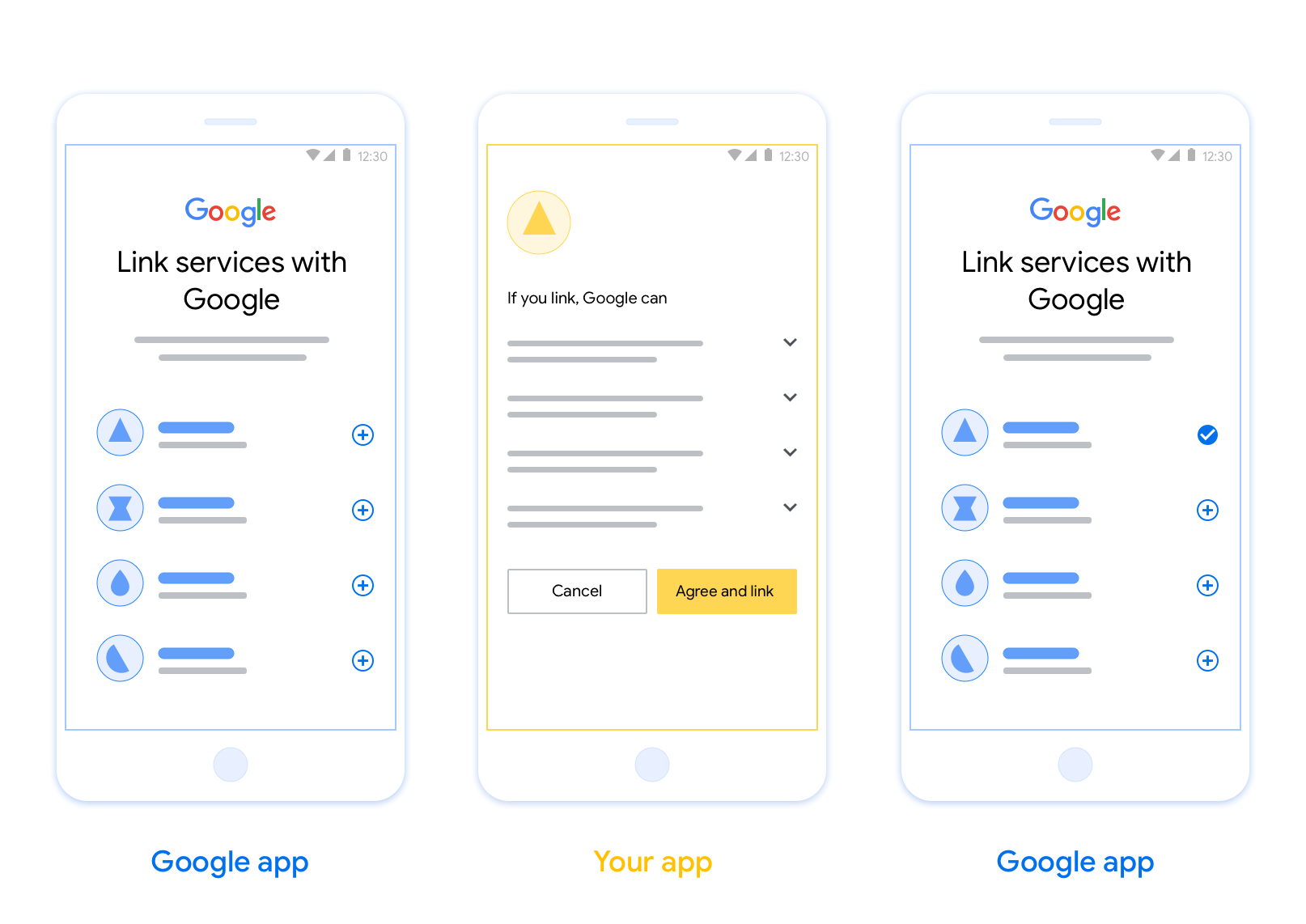
This figure shows the steps for a user to link their Google account
            to your authentication system. The first screenshot shows how a user
            can select your app if their Google account is linked to your app.
            The second screenshot shows the confirmation for linking their
            Google account with your app. The third screenshot shows a
            successfully linked user account in the Google app.
Figure 1. Account linking on a user's phone with App Flip.

Requirements

To implement App Flip, you must fulfill the following requirements:

  • You must have an Android or iOS app.
  • You must own, manage and maintain an OAuth 2.0 server which supports the OAuth 2.0 authorization code flow.

OAuth-based App Flip Flow

The following sequence diagram details the interaction between the User, Google App, Your App, and Your Authorization Server for App Flip.

User Google App Your App Google Server Your Auth Server 1. Initiates linking 2. Deep link to Your App 3. Show Consent Screen 4. User Grants Consent 5. Get Auth Code 6. authorization_code 7. Return to Google App 8. Pass code to Google Server 9. Token Exchange (POST) 10. access_token, refresh_token 11. Store user tokens 12. Access user resources
Figure 2. The sequence of events in the App Flip flow. If an authorization code is provided, the token exchange happens server-to-server, the same way it does in the browser-based OAuth linking flow.

Roles and responsibilities

The following table defines the roles and responsibilities of the actors in the App Flip flow.

Actor / Component GAL Role Responsibilities
Google App / Server OAuth Client Initiates the linking process, triggers a deep link to your mobile app, exchanges the authorization code for tokens, and securely stores them to access your service's APIs.
Your App Authorization Agent Authenticates the user (typically using existing app credentials), obtains consent, and retrieves an authorization code from your server.
Your Authorization Server Authorization Server Validates authorization codes and refresh tokens, and issues access tokens to the Google Server.

Design guidelines

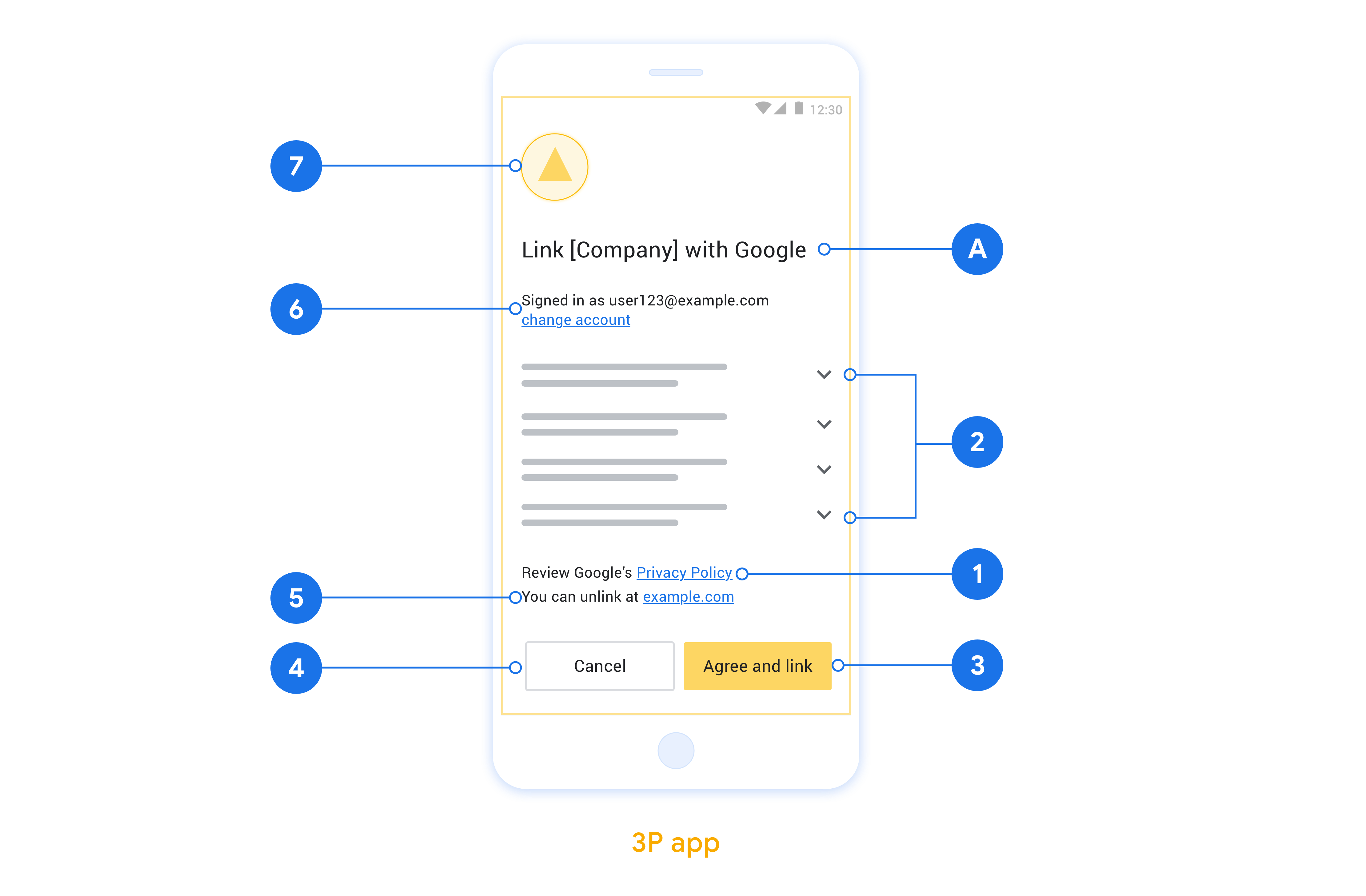
This section describes the design requirements and recommendations for the App Flip account linking consent screen. After Google calls your app, your app displays the consent screen to the user.

Requirements

  1. You must communicate that the user’s account is being linked to Google, not to a specific Google product, such as Google Home or Google Assistant.

Recommendations

We recommend that you do the following:

  1. Display Google's Privacy Policy. Include a link to Google’s Privacy Policy on the consent screen.

  2. Data to be shared. Use clear and concise language to tell the user what data of theirs Google requires and why.

  3. Clear call-to-action. State a clear call-to-action on your consent screen, such as “Agree and link.” This is because users need to understand what data they're required to share with Google to link their accounts.

  4. Ability to deny or cancel. Provide a way for users to go back, deny, or cancel, if they choose not to link.

  5. Ability to unlink. Offer a mechanism for users to unlink, such as a URL to their account settings on your platform. Alternatively, you can include a link to Google Account where users can manage their linked account.

  6. Ability to change user account. Suggest a method for users to switch their account(s). This is especially beneficial if users tend to have multiple accounts.

    • If a user must close the consent screen to switch accounts, send a recoverable error to Google so the user can sign in to the desired account with OAuth linking and the implicit flow.
  7. Include your logo. Display your company logo on the consent screen. Use your style guidelines to place your logo. If you wish to also display Google's logo, see Logos and trademarks.

This figure shows an example consent screen with call-outs to the
            individual requirements and recommendations to be followed when
            you design a user consent screen.
Figure 2. Account linking consent screen design guidelines.

アプリにアプリ切り替えを実装する

アプリ切り替えを実装するには、Google からのディープリンクを許可するようにアプリのユーザー認証コードを変更する必要があります。

Android アプリでアプリ切り替えをサポートするには、 Android 実装ガイドの手順に沿って操作してください。

iOS アプリでアプリ切り替えをサポートするには、 iOS 実装ガイドの手順に沿って操作してください。

アプリ切り替えをテストする

検証済みの本番環境アプリと動作する OAuth 2.0 サーバーが利用可能になる前に、サンプルアプリとテストアプリを使用してアプリ切り替えをシミュレートできます。

アプリ切り替え中、Google アプリが最初にアプリを開き、アプリが OAuth 2.0 サーバーに認証コードのレスポンスをリクエストします。最後のステップで、レスポンスが Google アプリに返されます。

前提条件

Google アプリをシミュレートしてアプリを起動するインテントをトリガーするには、 Android と iOS用のアプリ切り替えテストツールをダウンロードしてインストールします。

アプリをシミュレートして OAuth 2.0 レスポンス タイプを選択するには、 AndroidiOS 用アプリ切り替えサンプルをダウンロードしてインストールします。

テスト手順

  1. アプリ切り替えテストツールを開きます。
  2. [Try Flip!] を押して、アプリ切り替えサンプルアプリを起動します。
  3. サンプルアプリのラジオボタンからレスポンスを選択します。
  4. [Send] を押して、シミュレートされた OAuth 2.0 レスポンスをテストツールに返します。
  5. テストツールのログメッセージで、auth_code またはエラーの詳細を確認します。

本番環境でのテスト

登録と OAuth 2.0 サーバーの実装が完了したら、本番環境でアプリ切り替えをテストできます。

自動テストには、単一の Google アカウントと タスク固有のメールアドレス を使用することをおすすめします。

Google アカウントの所有者としてログインすると、 [リンク済みアカウント]でアカウントのリンク状態を確認できます。ここから、繰り返しテストの間にアカウントのリンクを解除することもできます。

必要に応じて、 RISC を実装して、 プログラムでリンクを解除し、変更を Google に通知することもできます。