
Stay up to date with the latest product announcements, technical deep dives, hardware partnerships, and developer stories from the LiteRT and Google AI Edge teams.
Featured announcements

ML Drift: Next-Gen GPU AI/ML Inference at the Edge
Accelerate on-device ML and generative AI inference across OpenGL ES, OpenCL, Metal, and WebGPU with Google's universal GPU compute framework.
LiteRT: The Universal Framework for On-Device AI
Google's unified on-device ML framework, evolving from TensorFlow Lite to deliver high-performance execution across mobile, desktop, web, and IoT platforms.

TensorFlow Lite is now LiteRT
Google introduces LiteRT as the evolution of TensorFlow Lite, expanding support across PyTorch, JAX, and Keras for unified edge deployment.
LiteRT: Maximum Performance, Simplified
Discover how the CompiledModel API streamlines on-device ML with automated accelerator selection, zero-copy buffer handling, and asynchronous execution across NPU, GPU, and CPU.

On-Device GenAI in Chrome, Chromebook Plus, and Pixel Watch with LiteRT-LM
Learn how LiteRT-LM brings small language models (SLMs) and on-device text generation directly into Chrome, Chromebook Plus devices, and Wear OS smartwatches.
Silicon & hardware acceleration
Discover how LiteRT collaborates with silicon leaders to unlock peak hardware efficiency and sub-millisecond inference latencies.
| Hardware Partner | Target Platform | Article Title | Link |
|---|---|---|---|
| Qualcomm | Snapdragon NPU | Unlocking Peak Performance on Qualcomm NPU with LiteRT | Read Article → |
| MediaTek | Dimensity NPU | MediaTek NPU and LiteRT: Powering the Next Generation of On-Device AI | Read Article → |
| Arm | Mali & Immortalis GPU | How Arm and Google are Improving ML Drift Performance on Arm GPUs | Read Article → |
| Arm | SME2 & XNNPACK | Accelerating On-Device AI: A Look at Arm and Google AI Edge Optimization | Read Article → |
| Intel | Core Ultra NPU & OpenVINO | EmbeddingGemma v2 Day-0 on Intel NPU through LiteRT-LM and the OpenVINO Backend | Read Article → |
| Intel | Core Ultra NPU | LiteRT Unlocks Core Ultra NPU Performance for AI PC | Read Article → |
| Raspberry Pi | Pi 5 CPU & VideoCore GPU | Mastering Edge AI on Raspberry Pi with LiteRT and Gemma | Read Article → |
| GPU (ML Drift) | ML Drift: Next-Gen GPU AI/ML Inference at the Edge | Read Article → | |
| Ecosystem Overview | Building Real-World On-Device AI with LiteRT and NPU | Read Article → | |
| Google Pixel | Tensor TPU | Google Tensor SDK Beta with LiteRT | Read Article → |
Generative AI & edge LLMs

Bring Multimodal Semantic Search to the Edge with EmbeddingGemma 2
Run private, low-latency multimodal retrieval and semantic search across text, vision, and audio on-device using EmbeddingGemma 2, MediaPipe, and LiteRT.

Introducing Support for Local AI Models in the Antigravity SDK
Build offline, privacy-first agents with the Antigravity SDK, running Gemma 4 26B A4B locally through LiteRT-LM, with hybrid cloud-and-local orchestration.
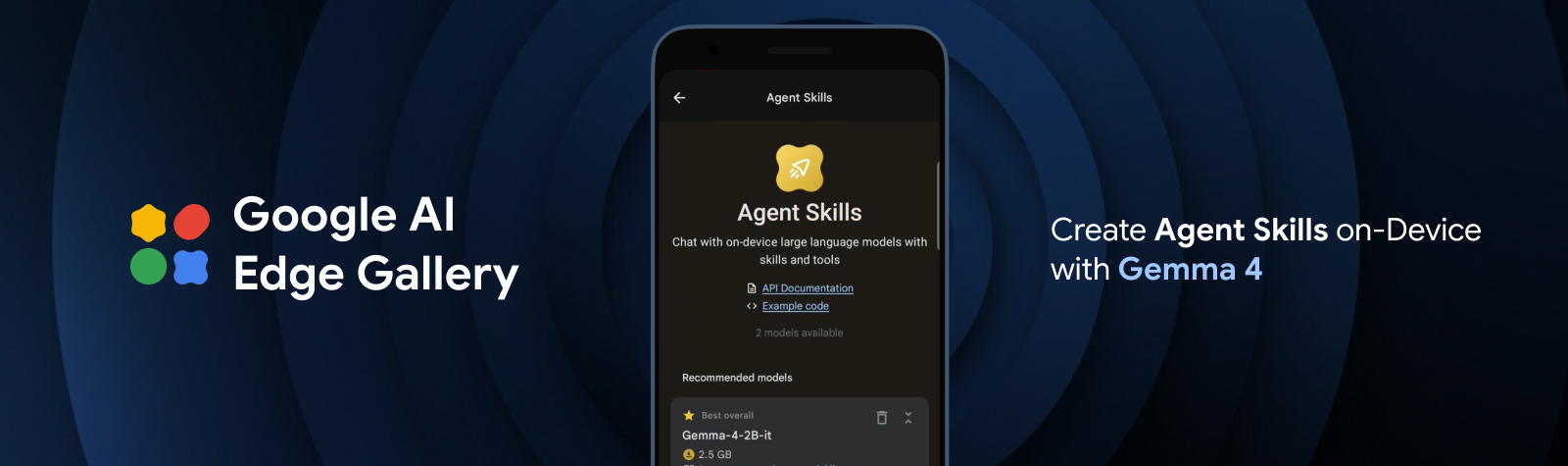
Bring State-of-the-Art Agentic Skills to the Edge with Gemma 4
Deploy agentic and multi-step planning capabilities entirely on-device with the new Gemma 4 family and LiteRT.
Blazing Fast On-Device GenAI with LiteRT-LM
Deploy Gemma 4 using LiteRT-LM with Multi-Token Prediction for up to a 2.2x speedup, dynamic loading, and built-in Swift and WebGPU APIs.
Mastering Edge AI on Raspberry Pi with LiteRT and Gemma
Deploy secure, real-time edge AI on Raspberry Pi 5 with LiteRT. Run Gemma models on CPU using XNNPACK, YOLO on VideoCore VII GPU, and orchestrate agentic workflows using the LiteRT CLI.

Google AI Edge: Small Language Models, Multimodality, and Function Calling
Explore the latest techniques in Retrieval-Augmented Generation (RAG), multimodal vision-language models, and function calling for edge language models.
Web & cross-platform deployments
LiteRT.js: Google's High-Performance Web AI Inference
Run high-performance ML and GenAI models in the browser using WebAssembly, WebGPU, and WebNN with the official LiteRT.js library.
Community & technical guides

Edge AI from the Trenches: A Practical Guide to LiteRT
A comprehensive multi-part community guide exploring the architectural differences between LiteRT and LiteRT-LM, quantization strategies, and production deployments.
Stay connected

